
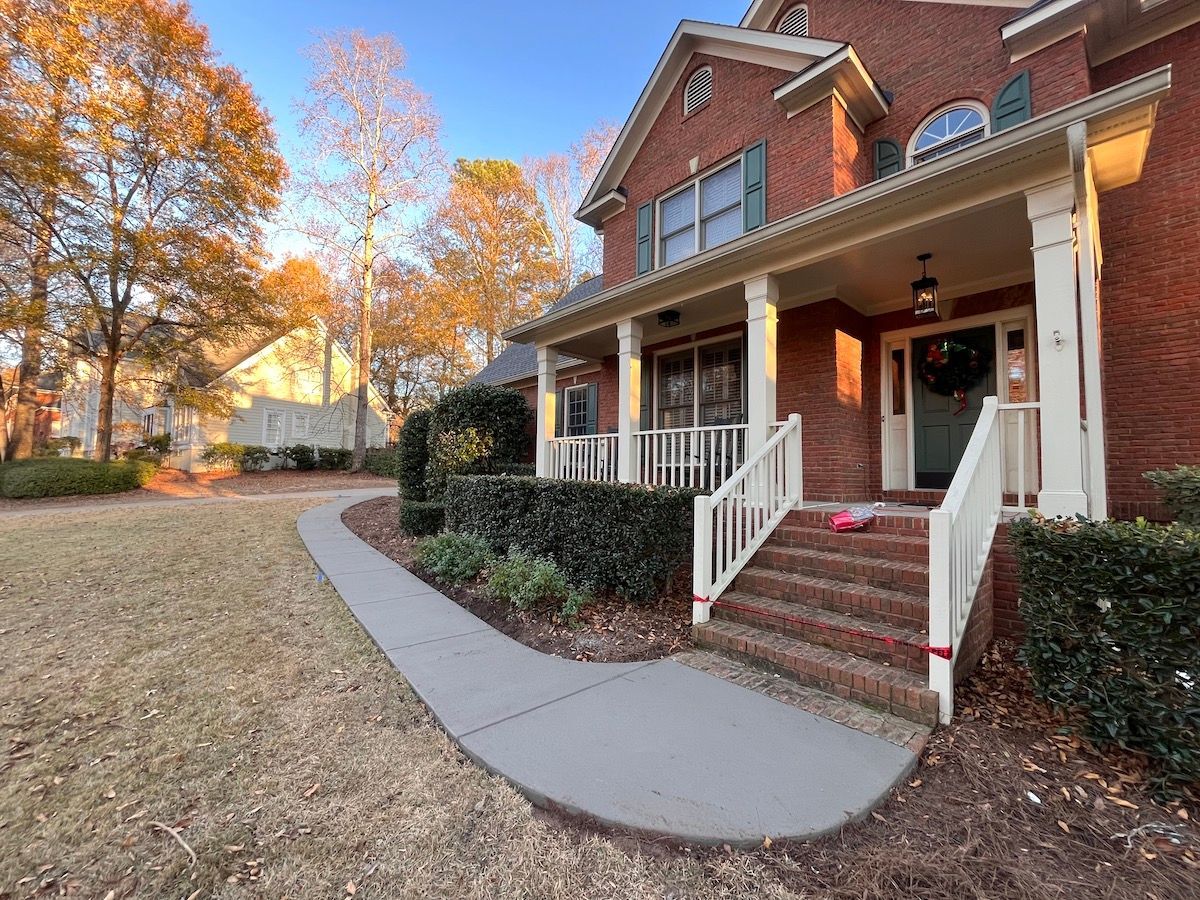
Eliminate Trip Hazards and Connect Your Property the Right Way.
Duffie Driveway Solutions installs concrete sidewalks and walkways across the Columbia area — connecting entry points, improving safety, and meeting accessibility standards.
A cracked, uneven, or nonexistent walkway is more than an eyesore — it's a liability. Whether visitors are stepping off onto grass to reach your front door, delivery drivers are navigating broken concrete near your entrance, or your property simply lacks accessible pathways between key access points, a properly installed concrete walkway solves the problem permanently. Duffie Driveway Solutions pours concrete sidewalks and walkways for residential and commercial properties throughout Columbia, Irmo, West Columbia, and surrounding areas.
Every walkway is graded with a slight slope to move water away from the structure and prevent pooling. The subbase is compacted and leveled before the pour to prevent the settling that creates low spots and tilting sections. Control joints are cut at regular intervals to manage cracking as the concrete expands and contracts with temperature changes. In the Midlands, where clay soils are common, base preparation is the difference between a walkway that lasts decades and one that requires replacement within a few years.
Request a quote and we'll measure the pathway layout and talk through finish options that work for your property and your budget.
What You Notice After the Concrete Cures
You'll have a smooth, level route that doesn't collect mud, shift underfoot, or require seasonal maintenance. Water runs off the surface rather than pooling in depressions. Wheelchairs, strollers, and delivery carts roll easily without catching on edges or uneven joints. The walkway can be finished with a broom texture for slip resistance, a smooth trowel finish for a cleaner look, or given a decorative treatment like exposed aggregate, stamped patterns, or color tinting to complement your existing hardscape.
We build walkways to local standards — width, slope, and joint spacing that meet code requirements. Thickness is determined by expected traffic and whether the walkway will need to support occasional vehicle crossings, like lawn equipment or service trucks. Wire mesh or fiber additives can be included to reduce surface cracking. Walkways are typically poured in sections so that if a single panel ever needs attention down the road, it can be addressed without tearing up the whole path.
Sidewalks near street frontage may require permits and must meet municipal width and setback rules. Walkways that cross drainage swales or connect to public sidewalks need additional coordination with local inspectors. We handle layout, grading, and finishing — but we don't include landscaping, lighting installation, or removal of large tree roots that interfere with the path. We'll flag anything like that during the site evaluation.
Common Questions About Sidewalk and Walkway Installation
Property owners ask about thickness, slope, finish options, and how long before the surface can be used.
What thickness is standard for a residential walkway?
Four inches is typical for foot traffic only — that covers most residential walkways connecting your home to the driveway, side yard, or street. If lawn equipment, service vehicles, or anything with wheels heavier than a wheelbarrow will cross the walkway regularly, thickness increases to match driveway specs. We'll size it correctly for your actual use during the estimate.
How is water managed along a concrete walkway?
The surface is sloped at least one percent grade away from the building so water sheds off the edge rather than running toward the structure or pooling in low spots. Control joints prevent water from settling into cracks. Proper slope is especially important in the Midlands where afternoon downpours are routine — a flat walkway doesn't stay flat for long.
When can I walk on a newly poured sidewalk?
Light foot traffic is typically safe after 24 to 48 hours. Full cure strength develops over 28 days, but normal everyday use can resume much sooner than that. We'll give you specific guidance based on your pour date and the weather conditions at the time of installation.
Why do control joints prevent random cracking?
Concrete shrinks as it cures and moves with temperature changes — that's physics, not a flaw. Control joints create a weak point in a straight line so that when movement occurs, cracking happens at the joint rather than wandering randomly across the surface of your walkway. Properly placed joints keep the slab looking clean and make maintenance predictable.
What finish options are available for walkways in the Midlands?
Broom finish is the standard choice — it provides slip resistance in wet conditions, which matters here. Smooth finish is cleaner looking and works well for covered walkways or more formal entrances. Exposed aggregate, stamped patterns, and integral color are all available if you want something more decorative that ties into your existing hardscape. We'll help you choose what fits the style and use of the space.
Contact us to schedule a site visit, review the walkway route and width requirements, and settle on the finish style that best fits your property and budget.