
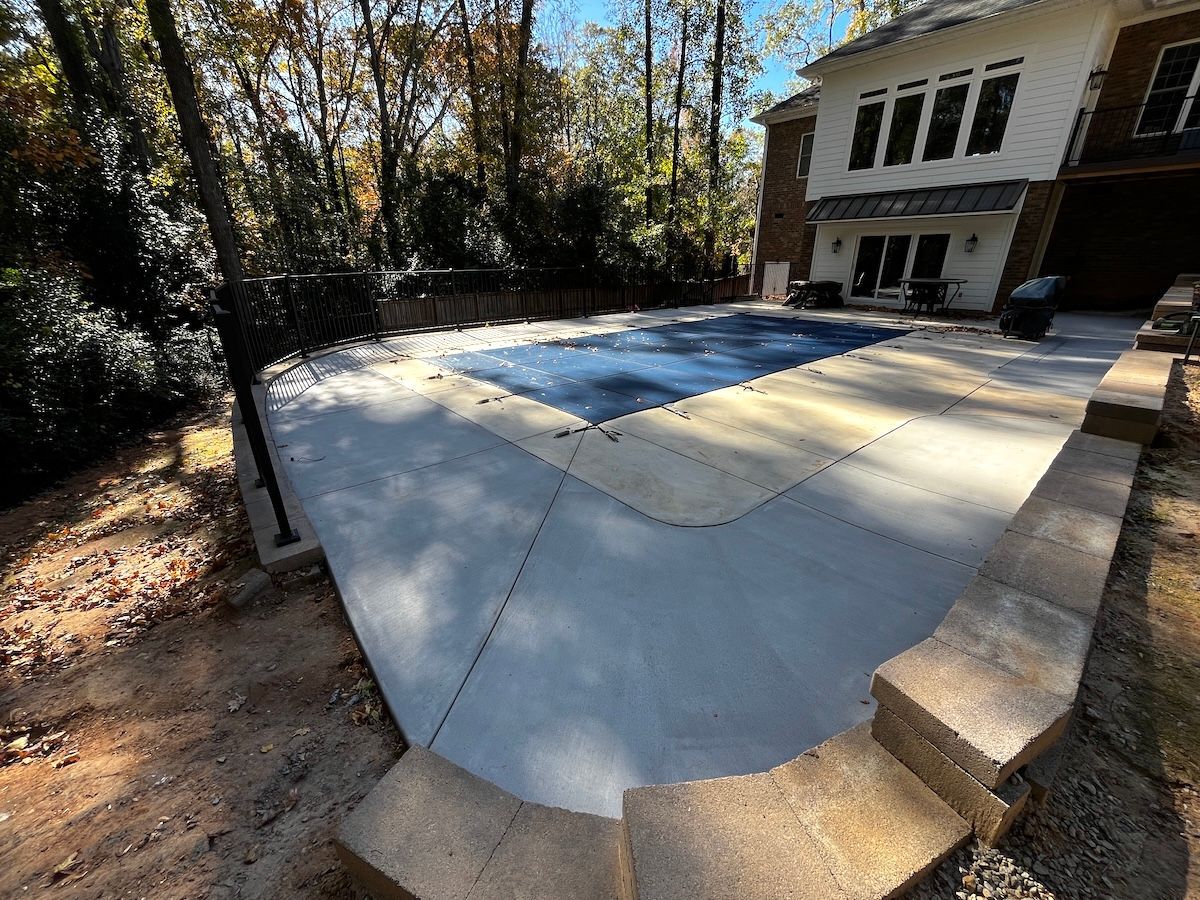
Safe Footing. Cool Surface. Built for a South Carolina Summer.
Duffie Driveway Solutions builds concrete pool decks for Columbia-area homeowners - slip resistant, durable, and designed to handle the heat, the water, and the years of use.
A pool deck takes a beating. It lives in direct sun, gets soaked daily, has to hold up to chlorinated water, bare feet, pool furniture, and the intense summer heat that's just part of life in South Carolina. If your existing deck has cracked from ground movement, if it's slippery when wet, or if your new pool installation left you with nothing but compacted dirt and temporary gravel — it's time to build a proper surface. Duffie Driveway Solutions designs and installs concrete pool decks throughout Columbia, Lexington, Irmo, and neighboring communities.
Every pool deck project starts with excavation and grading to match the pool coping height and direct runoff away from the pool and your home. A compacted gravel base supports the slab, reinforcement is set to manage stress from temperature swings and ground movement, and the surface is finished with a broom or brushed texture for traction when it matters most — when wet feet are involved. Expansion joints are cut at regular intervals to control cracking as the concrete expands and contracts through South Carolina's seasons.
Contact us for a site evaluation to discuss deck layout, finish options, and how the design will integrate with your pool shape and yard access points.
How Texture and Joints Manage Safety and Movement
The finish on your pool deck does more than look good — it keeps people safe. Broom and brushed finishes create small ridges across the surface that channel water and provide grip even on a soaked deck. If you prefer a decorative look, stamped concrete with a textured pattern can be used, but the texture depth must still meet slip-resistance standards for pool areas. Smooth finishes are not appropriate for pool decks, and we won't install them in that application.
After the concrete cures, you'll have a stable surface that stays level with the coping — no trip edges where the pool meets the walking surface. We place expansion joints every eight to ten feet and use control joints to guide any minor cracking into planned lines rather than random fractures. Sealing the surface after curing protects it from staining and makes cleanup much easier when sunscreen, leaves, or algae accumulate — which they will.
Pool deck work does not include pool installation, coping replacement, fencing, or landscaping. If the existing grade has drainage issues or soil is unstable, we address that during site prep. Any plumbing or electrical conduit that runs under the deck must be in place before the concrete pour — coordination with your other trades is your responsibility unless arranged separately.
What Homeowners Ask Before Starting a Pool Deck
Pool deck planning involves decisions about size, finish, and how the slab performs in wet conditions and high heat — here's what we hear most.
What thickness is standard for a residential pool deck?
Most pool decks are poured at four inches with rebar or wire mesh reinforcement. That handles foot traffic, poolside furniture, and standard residential loads without flexing. If you have heavier structures nearby — like a large pergola footing or outdoor kitchen — we'll look at those areas specifically.
How do expansion joints prevent cracking?
Concrete expands in the heat and contracts when it cools — in South Carolina, that happens a lot. Expansion joints give the slab room to move without building up stress that causes random cracking across the surface. We place them at regular intervals and plan their location so they're as unobtrusive as possible in the finished look.
When is the best time to pour a pool deck in Columbia?
Spring and fall are ideal — moderate temperatures support even curing without the rapid surface drying that Columbia summers can cause. Summer pours are absolutely doable, but we manage hydration and use curing blankets or misting to slow evaporation and prevent surface cracking. We'll plan accordingly for your pour date.
Why does the deck need a textured finish?
Smooth concrete becomes dangerously slippery when wet, and bare feet around a pool deserve better than a slip-and-fall waiting to happen. A textured finish provides friction without being rough or abrasive underfoot. It's not just about comfort — it's about safety, and we take it seriously on every pool deck we pour.
How much clearance is needed around the pool perimeter?
Most decks extend at least four feet from the pool edge — enough for safe walking access and basic poolside seating. If you want room for lounge chairs, dining furniture, or a grill area, we typically recommend six to eight feet or more on at least one side. We'll help you think through the layout during the consultation.
If you're ready to add a pool deck that prioritizes safety and holds up to South Carolina summers, let's schedule a site visit and talk through your layout and finish options.