
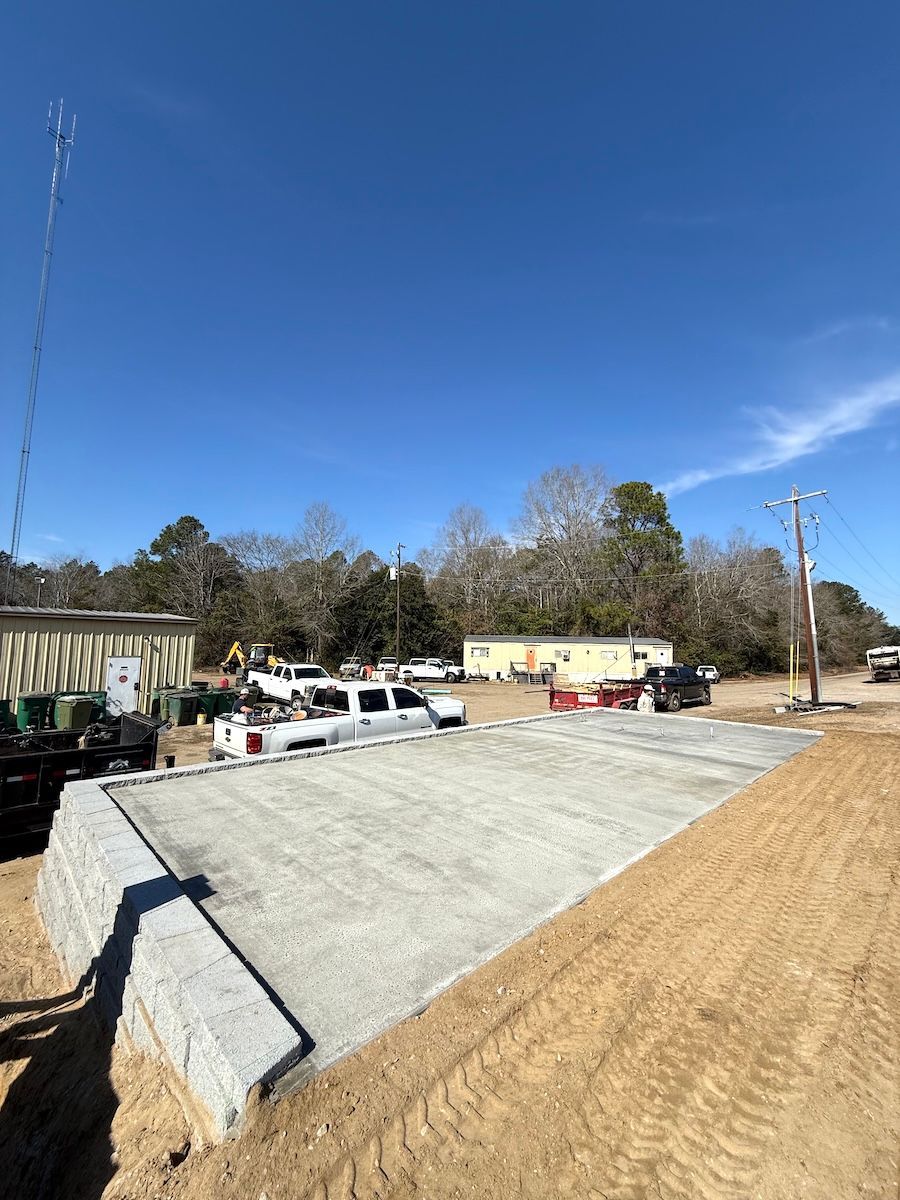
Start Construction on a Stable Foundation
Duffie Driveway Solutions pours building slabs and foundations in Columbia for residential and light commercial structures — level, properly reinforced, and ready for what gets built on top.
Everything that gets built above grade depends on what's below it. If you're adding a garage, workshop, retail space, or a home addition — and you need a slab that can support walls, roofing loads, and interior finishes without cracking or settling — the prep work and the pour have to be done right. Duffie Driveway Solutions provides concrete slabs and foundation work for new construction, additions, and outbuildings throughout Columbia, Lexington, Blythewood, and surrounding areas. The slab must be level, properly cured, and ready to meet the timeline your builder or contractor has set.
Preparation starts with grading the site to ensure proper drainage away from the structure. Soil is excavated to the required depth, compacted in layers, and topped with a gravel base that keeps moisture from wicking up through the concrete. Rebar or wire mesh is positioned to resist the tensile forces that cause cracking under load. Moisture barriers go down beneath the slab to prevent water vapor from migrating through — especially important in the humid Midlands climate where that moisture can damage flooring and promote mold growth. Thickness, reinforcement, and footing depth are all determined by the building design and local soil conditions.
Contact us to discuss square footage, thickness requirements, and project scope so your slab can be scheduled and poured in coordination with your builder.
What Happens After the Slab Is Poured
You'll have a flat, level surface that meets the elevation and dimensions specified in your building plans. The slab won't settle, tilt, or develop low spots that interfere with framing or interior finishes. Walls can be anchored directly to the concrete, and utilities like plumbing and electrical conduit are positioned before the pour so they emerge in exactly the right locations. Once cured, the slab provides a stable, ready platform for the rest of the construction process.
We coordinate with general contractors, framers, and inspectors to make sure the slab is ready when the next phase needs it. Reinforcement is placed according to engineering specifications, and concrete is poured in sections if the slab is large enough to require multiple loads. Edge footings are formed and poured to support exterior walls, and anchor bolts are set in wet concrete to secure sill plates. The surface is finished with a trowel or float depending on whether it will be covered with flooring or left exposed.
Foundation work doesn't include excavation for basements, sump pump installation, or complex drainage systems that require mechanical equipment. Slabs for homes with crawl spaces, pier-and-beam foundations, or elevated structures require different methods — those are handled on a case-by-case basis. Our focus is slab-on-grade construction where the concrete is poured directly over prepared soil.
Questions About Slabs and Foundation Work
Builders and property owners ask about thickness, curing time, moisture barriers, and how the slab connects to footings.
What thickness is required for a building slab?
Four inches is standard for residential floors — garages, workshops, and living space additions. Slabs that will support heavy equipment, commercial loads, or multi-story structures may require six inches or more, with additional reinforcement. The building design and local soil conditions are what determine the spec, and we'll make sure the slab matches what your engineer or building department requires.
How long does a slab take to cure before framing can begin?
Framing can typically start within a few days of the pour, but full structural strength develops over 28 days. Weather and project schedule both play a role — hot, dry conditions can accelerate surface drying but slow deep curing, while cooler temperatures slow the process overall. We'll coordinate with your builder so the timeline works for everyone involved.
Why is a moisture barrier important under a concrete slab?
Without a vapor barrier, ground moisture moves up through the concrete and into the structure above it. In the Midlands, that means humidity damage to flooring, conditions that promote mold growth, and reduced indoor air quality — all problems that are expensive to fix after the fact and easy to prevent with a polyethylene barrier installed before the pour.
When is rebar required instead of wire mesh?
Rebar is used when the slab must support concentrated loads, when the building has multiple stories, or when local codes specify it for the structure type. Wire mesh handles distributed loads and surface cracking well for standard residential applications. We'll specify the right reinforcement based on your building design and what's required in your jurisdiction.
What happens if the soil is not compacted correctly?
An improperly compacted subgrade will settle unevenly under load, causing the slab to crack, door frames to shift, and interior finishes to separate from walls. In Columbia's clay-heavy soil, this is a real risk — clay expands when wet and contracts when dry, and a slab sitting on uncompacted clay can move significantly over a few years. Proper compaction in lifts before the pour is non-negotiable on any foundation work we do.
We work with engineers, builders, and inspectors to make sure your slab meets structural requirements and is ready for the next phase of construction. Reach out to review your project timeline and confirm slab specifications before work begins.